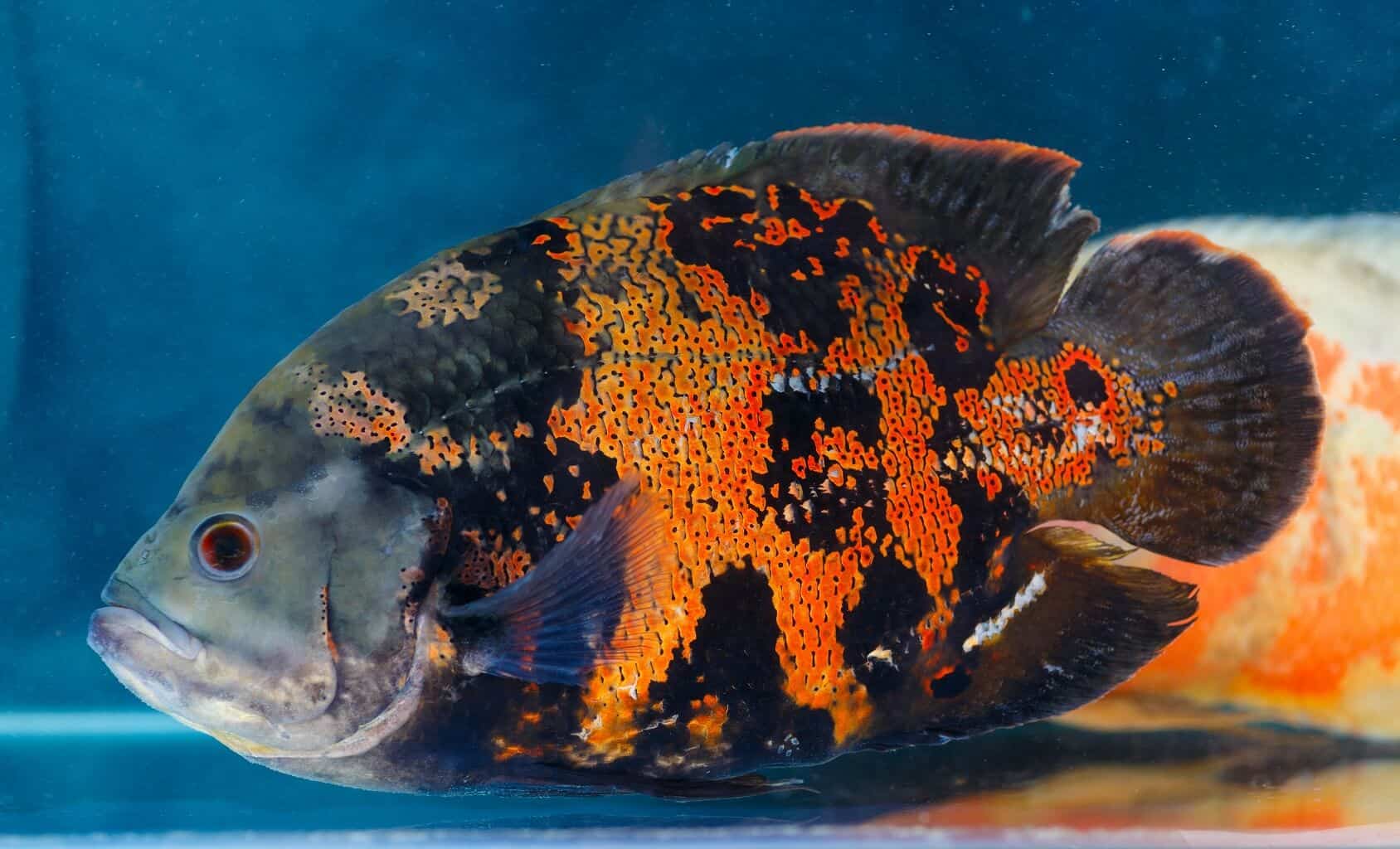
The Oscar (lat. Astronotus ocellatus) is a large, brightly colored cichlid from South America. In addition to its large size and attractive color, the oscar is also considered a highly intelligent fish with interesting behavior. This fish is rather small in the juvenile stage, but quickly grows to full size (up to 35 cm) and of course attracts the attention of any aquarist. Astronotus is one of the fish that can be described as the fish with some kind of intellect and character.
The fish will watch you go about your business in the room and see that you do it more conscientiously than other small cichlids.
Some fish will even let you touch them, like a pet cat, and it seems that the fish is enjoying it. Taking food from your hands is not a problem at all for Oscars, but be careful – it can bite you.
Although the wild species is still popular and widely available, but lately quite a few new types of amazing colors have been bred that are popular as well.
They are all beautiful, but the red one is especially attractive – it is a dark-colored bodied fish with red or orange spots on it. Apart from red there are also albino Oscars (completely white or with red spots), blue, and so on.
But all these morphs are still basically classic Astronotus ocellatus. They are the same in terms of maintenance and feeding, except for some types that are more demanding and tend to get sick.
Luckily for aquarists, it is fairly easy to care for and can be successfully kept in a tank even by beginners. Their size is the only thing that makes them problematic when kept in a tank.
They grow very fast and in that they eat all the smaller fish in a tank. Astronotus like all large and omnivorous cichlids should be kept in a tank of 100 gallon capacity and larger.
It is preferable to keep this fish alone without any tankmates.
habitat in the wild
Astronotus was first described in 1831. The fish can be found in South America: Amazon River Basin, Negro River, Paraná River, and Paraguay River.
Oscar was accidentally brought to China, Australia, Florida, where he acclimatized rather quickly and began hunting local species to extinction.
In its native habitat your cichlid is considered a valuable food fish. In the wild fish lives both in large rivers, canals, ponds, lakes with a sandy or muddy bottom. It feeds on fish, lobsters, worms and insects.
Description
The Oscar has a strong oval-shaped body with a bid head and large, thick lips. In the wild the maximum size can be about 45 cm, but in an aquarium the fish is smaller: about 20-25 cm.
If given good care, the useful life can be about 10 years and more.
The species that live in the wild are usually rather moderately dark in color with orange spots on their back and gills.
There is a large black spot with orange edges on the caudal fin. Due to this stain the fish was named Astronotus ocellatus.
Both wild and man-made species change their color quite quickly when stressed, during fights, or when protecting their territory.
maintenance difficulties
Although the oscar is an interesting and easy to care for fish, it is important not to judge it by its juvenile size and peaceful behavior.
Most of the fish for sale are about 3 cm long and in this period of time it is kept in a community range together with other fish.
So be careful not to buy this fish to keep in your 20-gallon community tank. Oscars grow very fast and for proper growth you need a tank of 100 gallons capacity or more, also the food for this fish is quite expensive.
Also, the oscar is a raptor feeder that should be kept in a separate tank with its mate or in a very large tank with large tank mates.
However, don't freak out. If you are sure this is the fish you want – go ahead – the fish is easy to care for and soon you will have a nice, smart and almost pet.
Care and maintenance in a tank
Diet
Scientific name
Astronotus ocellatus
Common name
Oscar, oscar fish, tiger oscar, velvet cichlid, marble cichlid
tank size
100 gallons (400L) and more
Temper
territorial/aggressive
Omnivorous/Predatory
Water temperature
75-81°F (24-27°C)
pH
6.5-7.5
Size
45cm (18in)
It is a very large fish and you need to have a fish tank of a suitable size. Due to the fact that even the sex of mature fish can almost be defined it is recommended to buy a group of 4-6 juveniles to keep in a tank and let them choose their mate.
The best matched pair is left in one tank and the others are transferred to other tanks. The juveniles will be quite comfortable in a 30 gallon capacity tank, but when they get older they will need a 100 gallon or larger tank.
If you are planning to have this pair for breeding a much larger tank is required to decrease the number of fights between the fish.
Oscar prefers water with high oxygen content, but does not like the presence of flowing water, therefore it is required either to use aeration or to feed water from an external filter through the pipe above. the surface of the water.
Since the fish is very big and quite active make sure that the equipment and design elements of the tank are installed reliably or even better that they have some protective cover or etc.
It is good to hide the heaters with large rocks or other tank decorations. The fish can start playing with the decorations by attacking them, so due to the size it can end up quite sad for the decorations.
If your oscar tends to behave like this, you can fool them by putting something in a tank that will distract them from the tank's equipment.
The bottom should be sandy as fish like to dig into it. In general, Oscar loves to change the inside of the tank to his liking – he digs, turns, takes out and throws things. So all the rocks and snags have to be quite bulky and heavy and the artificial plants have to be anchored with something heavy at the bottom.
Other than that Oscar is a fairly peaceful and slow fish, shy enough that even a lift net placed in the tank can cause him to hide in the corners of the tank or even lie down on one side.
The fish is quite intelligent, it gets used to its owner quite quickly and takes food from your hands, sometimes even letting you touch it.
In case you intend to create some kind of landscape in your tank so that everything looks nice and perfect, please remember – the fish is the boss in the tank, not you. The fish will scavenge and remove anything they can see.
It is highly recommended to cover the tank, so you will avoid splashes when feeding the fish and they will not jump out of the tank.
Feeding
In nature, the oscar is europhagous and eats different foods that include: insects, larvae, zooplankton, plants and algae, fish, spineless species, etc.
The fish feeds quite simply, however it is desirable to give it animal food. The basic food should be qualitative food for large cichlids - pelleted food.
Live or frozen food can be some addition to the main diet. As for me, I use several different types of food, and change them from time to time.
The fish enthusiastically feed on earthworms and ooze, as well as crickets, shrimp, fillet, mussel meat, frog larvae, grasshoppers and other large foods.
Sure, the oscar will feed on edible fish, for example guppies or goldfish, but this should only be done if you are sure that these fish are healthy and will not infect the fish they are fed with.
The oscar is very petty and has an insatiable greed, so it is important not to overfeed it, as it can cause illness and even death.
There were times when cichlids were fed mammalian meat, but nowadays it is best avoided.
The thing is that such meat cannot be well digested by fish due to the high protein and fat content it contains. This leads to fatty degeneration and dystrophy of the viscera.
As for the ox heart, it is better to feed the fish once a week so as not to burden the stomach.
I myself give some of this food to my pets and for the rest I have heard and read many good reviews.
However, all the food is of high quality and is the best for this type as well as keeping the aquarium water clean.
Compatibility and tank mates
This is absolutely not the fish for community aquariums (whatever the seller says). While the fish is young it behaves quite well with other tank mates, but when it reaches 10-12 cm (4-5 in) in length and becomes reproductive the fish also becomes aggressive and it is best to keep a mate in a tank since then or maybe several fish together if tank capacity allows.
Tankmates can be just big fish or especially spiny ones – jaguar cichlids, green terror, Jack Dempsey cichlids and other cichlids, large armored sailfin pleco and common pleco. All the fish except these will be eaten or at least bitten by the fish.
Sex
It is very difficult to see between male and female. Who is who can be defined with certainty only during her spawning period by the fact that the female has an ovipositor.
Breeders usually buy about a dozen juveniles and grow them together to let the fish choose their mate for themselves.
Breeding
Since the oscar becomes reproductive the pair will occasionally spawn in the tank. Since they are the only fish in the tank it is possible to farm the eggs without creating a spawning pond on purpose.
Keep in mind that despite his size, Oscar is quite shy and reacts very fussy to any noise or movement near the tank with the juveniles. In the worst case all eggs and juveniles will be eaten.
In the event that there are some tank mates in the tank for the sake of the juveniles and the safety of the tank mates (oscar in rage can easily kill or injure even fairly large fish if he is certain that he threatens his juveniles ) it is better to have a separate tank of about 30 gallons capacity and more for spawning (best results were obtained when tank size is 100x50x50cm).
A large, flat rock should be placed at the bottom of the tank where the eggs will be laid, substrate is not necessary. The water has to be non-hard with neutral reaction, lighting does not make a big difference, the temperature of the water has to be raised up to 26-28 °C.
During the spawning period the fish becomes very bright in color, the body turns dark black and the spots turn bright red.
Sometimes the male is not very nice to the female at first, but if the pair is separated by a glass wall for several days the male will become more tolerant of the female.
For a day or two the pair thoroughly cleans the rock surface, and then they begin to spawn. The female lays her eggs in rows on the rock for 4-5 hours. The eggs are large and oval. Their number can be around 1000 and more, since the fish is not only big, but also quite fruitful. Both parents care for the eggs – they flap them with their fins, remove spoiled eggs, and care for the ich fry. In 6-7 days the ich fry become juveniles and start swimming and feeding.
The juveniles start to feed on brine shrimp, cyclops, as the fish grows it can be fed with cut tubifex.
In addition, the parent fish during the first days have some nutritional secret in their body and the juveniles eat it from the grown body. Juveniles try to get closer to their parents and swim in small schools around them.
Astonotus juveniles grow rapidly but at a different rate, so they must be sorted frequently in a tank to prevent larger juveniles from eating smaller ones.
In addition, a large number of fast-growing juveniles (up to 2 cm) require 20% water renewal every day and a powerful filter in their tank.
Here we show you all the details about the Genshin Impact fishing system. Find out how to unlock it, what types of rods and baits exist, what are the fishing points and much more. How to unlock the fishing system? Requirements First of all, before we get down to business with fishing in Genshin Impact, you should know that this system is not accessible from the beginning for all players. Some prerequisites must be met to be able to fish in the game, which are the following: You must have activated the Kettle Relaxer system . To complete this first step you will need: Have already reached Adventure Rank 35 or higher. Completed Archon quest - Chapter 1: Act III: A New Star Rising. Finished quest Teapot Sweet Teapot. You must have completed the Watery Boom world quest (the Katheryne delivery from the Adventurer's Guild in Mondstadt). After meeting these two requirem...
Fish keeping as a hobby has many benefits. After setting up a saltwater aquarium by yourself, you will now be able to relax and enjoy the graceful movements of the fishes , and feast your eyes on the beautiful sight inside the tank. With saltwater aquariums, compared to freshwater ones, you have a wider selection of which fish to keep because saltwater fish comes from the vast oceans and seas. If saltwater aquariums interest you, you should be aware that saltwater fishes for such are sensitive to a change in the environment , and because they are caught in the sea, the cost of handling and shipping them is expensive. Before setting up a saltwater tank, you should first buy the necessary equipments and supplies. You would want to create a marine inhabitant suitable for your saltwater species. One important thing to include in your list is heaters. They are used to regulate the temperature inside the tank for the fishes, especially tropical ones, to survive. Furthermore, you will need po...
It is known as the horn shark, horned shark, or Heterodontus Francisci , the latter being its scientific name . It is part of the family Heterodontidae and is a species of heterodontiform elasmobranch . Where does the horn shark live? This peculiar fish has few habitat areas, it is usually located in Mexico, specifically in the Sea of Cortez, and in Central California of the United States. Although, there are records that indicate their presence in countries such as Peru and Ecuador, but it is believed that they must be very low populations. Their preferred areas are caverns, large rocks, forests full of algae, and reefs in general, at distances from the surface that vary according to the age of the specimen, but are usually between 2 and 150 meters in depth. depth. Young horn sharks tend to be in a constant state of movement, while the adults go out for their nightly hunt, but return to their hiding places daily when ...


Comments
Post a Comment